Real estate is one of the most crowded corners of local search. National listing portals own the top of the results for almost every “homes for sale” query, and every local agent is fighting over what is left. Ranking an independent team’s website in that environment takes more than a few blog posts.
This real estate SEO case study shows how we helped an established residential real estate team in suburban Pennsylvania win a much bigger share of that search demand. The numbers below compare the last six months of Google Search Console data with the six months before.
Results at a Glance
| Client | Established residential real estate team (buyers and sellers) |
| Region | Suburban Pennsylvania |
| Time frame | Last 6 months vs. previous 6 months |
| Services | Technical SEO, on-page optimization, content strategy, local SEO, authority building |
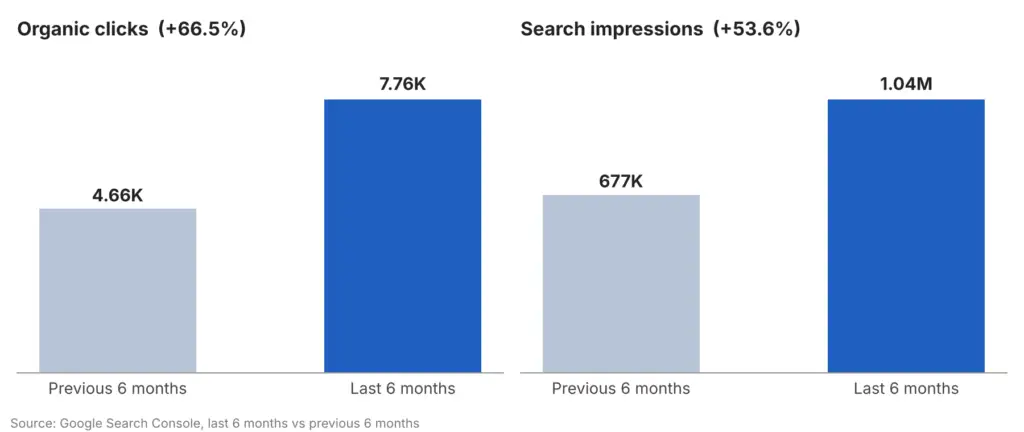
| Organic clicks | 4,660 → 7,760 (+66.5%) |
| Search impressions | 677K → 1.04M (+53.6%) |
| Average CTR | 0.7% → 0.7% (held steady while visibility grew) |
About the Client
Our client is a multi-agent residential real estate team that helps buyers, sellers and downsizing homeowners across a group of well-established suburban communities. The team has decades of local experience, a strong referral reputation and a content-rich WordPress website with IDX property listings, seller and buyer service pages, a home valuation tool and community resources.
In other words, they were not starting from zero. They had a solid brand and plenty of content. The problem was that Google was not rewarding it the way it should.
The Challenge
When we reviewed the account, three issues stood out:
- Page-two visibility. Across all queries, the site’s average position sat at 12.3, which is the top of page two. Pages ranking there get seen, but they rarely get clicked.
- Portal competition. Zillow, Realtor.com and Redfin dominate broad real estate searches. A local team cannot win by targeting the same head terms with the same kind of pages.
- A site that had grown without a plan. Like most agent websites running IDX, the site carried a large number of listing URLs, page-builder bloat and service pages that were not clearly aligned with how buyers and sellers search.
For a real estate team, this has a direct cost. Every homeowner who searches for a local agent or a home valuation and lands on a competitor’s page is a listing appointment that never happens.
Goals and KPIs
We agreed on goals that tie search visibility back to business value:
- Grow organic clicks to the site from Google, especially to seller, buyer and valuation pages.
- Expand search impressions across local, neighborhood and long-tail real estate queries.
- Keep click-through rate stable as the site entered more search results.
- Build visibility the team owns, rather than relying on portals and paid ads for leads.
We tracked progress in Google Search Console using clicks, impressions, average CTR and average position.
Our Strategy and Process
At Ranks Grow, every engagement starts with a full audit before any changes go live. For this client, the audit showed that the site’s problem was not a lack of content. It was structure, focus and trust signals. Here is how we approached it.
1. Technical SEO Cleanup
Real estate sites built on page builders with IDX feeds tend to have the same technical issues, so we started with the technical SEO improvements we prioritize first. That meant reviewing which listing and filter URLs deserved to be indexed, tightening the sitemap, improving page speed and mobile experience, fixing internal linking gaps and adding structured data so Google clearly understands the business as a local real estate agent.
Why this came first: if Google spends its crawl budget on thousands of thin listing variations, your most valuable pages get less attention. Cleaning this up lets the rest of the work pay off.
2. On-Page Optimization of Money Pages
Next, we focused on the pages that generate business: seller services, buyer services and the home valuation page. We rewrote title tags and meta descriptions around real search intent, restructured headings, added answers to common buyer and seller questions and connected these pages through clear internal links.
3. Content Clusters Around Buyer and Seller Intent
Instead of competing with portals on broad terms, we built content clusters around high-value topics that a local expert can win: neighborhood and community guides, selling and pricing advice, buyer guidance and resources for homeowners who are downsizing. Each cluster links back to the relevant service page, which builds topical authority and sends visitors toward a conversion.
4. Local SEO and Google Business Profile
Real estate is a local decision, so local SEO for Pennsylvania businesses was a core part of the plan. We optimized the Google Business Profile, made sure the business name, address and phone number were consistent across directories, and strengthened location signals on the site so the team shows up for searches in the communities they actually serve.
5. Authority and Trust Signals
Google holds real estate content to a high standard of trust. We strengthened E-E-A-T signals with detailed agent bios, clear credentials, reviews and existing media mentions, and supported the site’s authority with relevant, high-quality links.
Approximate Timeline
- Phase 1: Full audit, technical fixes and on-page optimization of key service pages.
- Phase 2: Content cluster rollout, local SEO and Google Business Profile optimization.
- Phase 3: Authority building, content refreshes and ongoing monitoring in Search Console.
The Results
Comparing the last six months with the previous six months in Google Search Console, the site grew on every volume metric that matters:
| Metric | Previous 6 months | Last 6 months | Change |
| Organic clicks | 4,660 | 7,760 | +3,100 (+66.5%) |
| Search impressions | 677K | 1.04M | +363K (+53.6%) |
| Average CTR | 0.7% | 0.7% | Held steady |
| Average position | 12.3 | 12.6 | Stable (broader keyword footprint) |
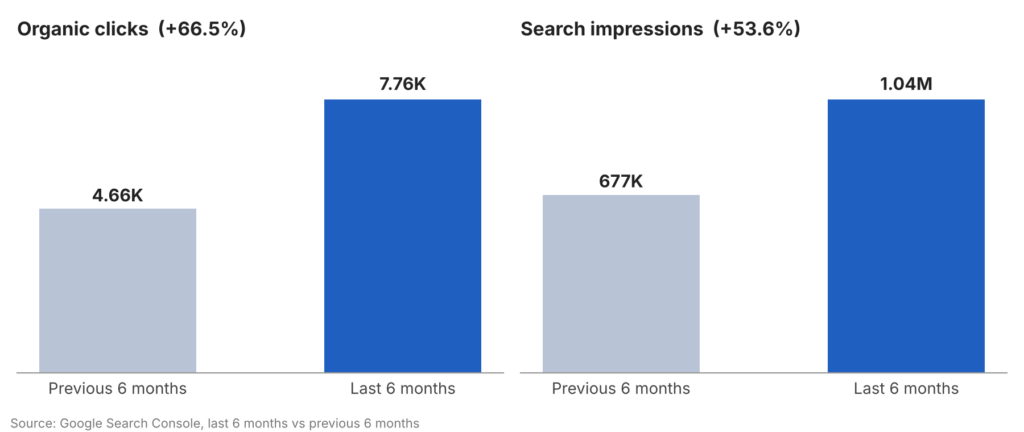
Organic clicks and search impressions, last 6 months vs. previous 6 months (Google Search Console)
What These Numbers Mean
- 3,100 more visits from Google. Organic clicks grew from 4,660 to 7,760, which works out to about 17 extra visitors from search every day.
- Over 1 million impressions. The site appeared in Google results 363,000 more times than in the previous six months, putting the brand in front of far more local buyers and sellers.
- Clicks grew faster than impressions. Impressions rose 53.6%, while clicks rose 66.5%, and CTR held at 0.7%. The new visibility is bringing in visitors at the same rate as before, not just empty impressions.
- A stable average position, even with a much bigger footprint. Average position moved from 12.3 to 12.6. When a site starts ranking for many new long-tail queries, those queries often enter at lower positions and pull the average down slightly, even while total traffic climbs. This is why we judge success by clicks and impressions, not average position alone.
For a real estate team, the business value is clear. A single seller who finds the team through search can be worth thousands of dollars in commission. More qualified visitors reaching seller, buyer and valuation pages means more listing opportunities, without increasing ad spend.
Key Takeaways
- Fix the foundation before scaling content. On IDX-heavy real estate sites, crawl and indexing issues can quietly hold back every other page.
- Do not fight portals head-on. Win the local, neighborhood and seller-intent searches that national sites cannot answer as well as a local expert.
- Build clusters, not one-off posts. Grouping content by topic and linking it to service pages builds authority and drives conversions.
- Protect CTR as visibility grows. Strong titles and meta descriptions are what turn new impressions into actual visits.
- Read average position in context. A wider keyword footprint can move the average slightly while traffic grows significantly.
Want Results Like These for Your Real Estate Business?
If your website is stuck on page two while portals and competitors take your leads, we can help. Start with a free SEO audit and consultation, and we will show you exactly where your site is losing visibility and what we would do to fix it.
Frequently Asked Questions
How long does real estate SEO take to show results?
Most sites see early improvements within 60 to 90 days, with significant growth by around month six. In this case, the gains are measured across a full six-month period compared with the six months before.
Can a local real estate team outrank Zillow or Realtor.com?
Not for every broad search. But for neighborhood, community and seller-intent searches, a well-optimized local team site can absolutely compete, and those are often the searches that lead to listing appointments.
Why did average position change slightly while traffic grew?
Average position is calculated across every query a site appears for. As the site started showing up for many new long-tail searches, some entered at lower positions, which nudged the average from 12.3 to 12.6 while clicks grew by 66.5%.
What does an SEO campaign for a real estate website include?
Usually a technical audit, on-page optimization of service and valuation pages, a content plan built around buyer and seller questions, local SEO and Google Business Profile work, and authority building through reviews, mentions and quality links.