Hotels live and die by visibility. If a traveler searching for a long-term stay finds an online travel agency first, the brand loses the direct booking, the guest data, and a slice of its margin. That was the problem we set out to solve in this hotel SEO case study.
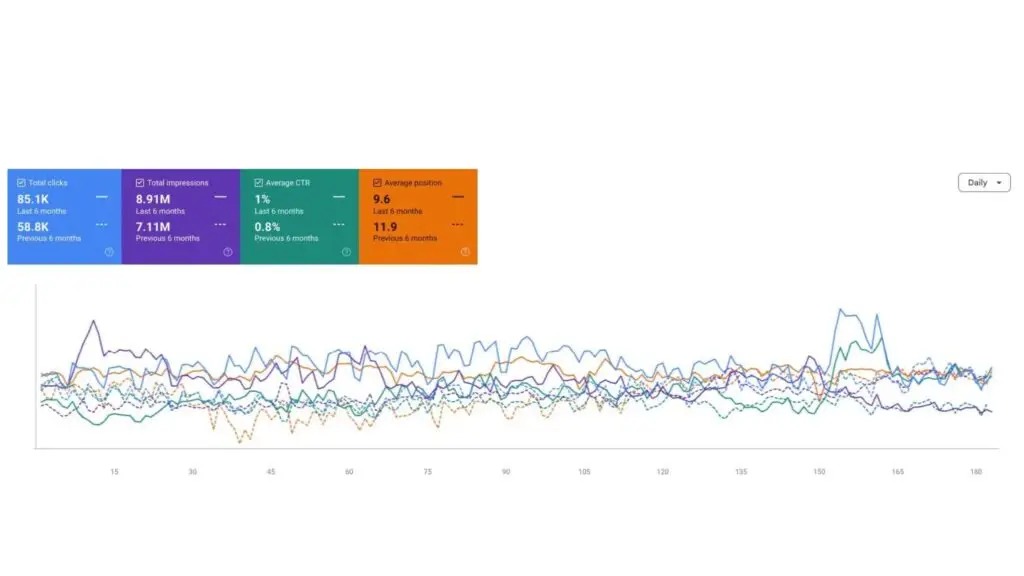
At Ranks Grow, we partnered with a growing U.S. extended-stay hotel brand to win back more of its search demand. Over six months, organic clicks rose from 58.8K to 85.1K (+44.7%), impressions grew from 7.11M to 8.91M, and the site’s average Google position moved from 11.9 to 9.6, from page two onto page one.
Results at a Glance
| Industry | Hospitality: extended-stay hotel brand (owned and franchised properties) |
| Region | United States, multi-state portfolio |
| Time frame | Last 6 months compared with the previous 6 months |
| Services delivered | Technical SEO, on-page and SERP snippet optimization, location page and content strategy, internal linking, ongoing Search Console monitoring |
| Organic clicks | 58.8K → 85.1K (+44.7%) |
| Impressions | 7.11M → 8.91M (+25.3%) |
| Average CTR | 0.8% → 1% |
| Average position | 11.9 → 9.6 (2.3 positions higher) |
About the Client
Our client is a U.S. hotel brand built around extended stays. It operates and franchises newer, value-focused properties across many states, serving families, business travelers, project crews, and leisure guests who need a room for a week or longer rather than a single night.
Direct booking matters to this business. The brand runs its own loyalty program with member-only rates, and its website carries a locations directory, special offers, corporate and group travel pages, and a blog. Every guest who books through the website instead of a third-party channel is worth more to the brand and to its franchise owners.
The Challenge
The site already had reach. Over the previous six months it earned 7.11 million impressions in Google. The problem was what happened next: only 58.8K of those impressions turned into clicks, a CTR of 0.8%. Our audit pointed to four connected issues.
- Rankings stuck just off page one. An average position of 11.9 meant many valuable queries sat at the top of page two, where very few searchers ever look.
- Heavy competition from OTAs and big chains. Booking platforms and national brands dominate hotel results, so a mid-sized brand has to earn every click with stronger relevance and better snippets.
- A multi-location structure that was hard to scale. Location discovery leaned on state-level listings and dynamically generated results pages, which can dilute crawl budget and leave individual hotels with thin, similar pages.
- Inconsistent on-page signals. We found mismatched page and social titles, generic metadata, and images without descriptive alt text, all small issues that add up across a large site.
Goals and KPIs
We agreed on goals that tie search performance to direct bookings:
- Move core brand, extended-stay, and location queries from page two onto page one.
- Grow organic clicks to the website, the main source of commission-free bookings.
- Lift CTR by making search snippets more relevant and more compelling.
- Expand impressions for location and long-stay queries in the markets the brand serves.
We tracked progress in Google Search Console using four KPIs: total clicks, total impressions, average CTR, and average position, comparing each six-month period with the one before it.
Our Strategy and Process
Hotel SEO rewards structure and consistency more than one-off tricks. We ran the work in overlapping phases so that the technical fixes landed first and every later improvement had a clean foundation to build on.
Phase 1 (Month 1): Audit and Technical Foundation
We crawled the site, reviewed index coverage in Search Console, and mapped how location pages were discovered. Our focus was on parameter-based results pages, canonical tags, XML sitemaps, and mobile page speed. We also reviewed structured data so that Google could clearly understand the brand, its hotels, and its page hierarchy.
Why: Rankings can’t climb if Google wastes crawl budget on near duplicate URLs or misreads which page should rank. Fixing crawl and indexing first makes every later change count.
Phase 2 (Months 1–3): On-Page and Snippet Optimization
Next, we rewrote title tags and meta descriptions for the homepage, location pages, and key brand pages. The new snippets put searcher priorities up front, such as extended-stay value, in-room kitchens, and member rates. We aligned social metadata with page titles, tightened heading structure, and added descriptive alt text. This is the core of our on-page SEO and content marketing services, and it is often where hotels find the fastest gains.
Why: With millions of impressions already in place, a better snippet is the cheapest way to win more clicks. Even a small CTR lift multiplies across that volume.
Phase 3 (Months 2–5): Location Pages and Content Depth
We strengthened the location experience so that individual hotels and states had clearer, more useful pages. That meant richer local context, extended-stay details, and answers to the questions long-term guests actually ask. On the blog, we focused on travel planning and long-stay topics that connect naturally to booking pages.
Why: Location and long-stay searches carry real booking intent. Pages that answer those needs earn more impressions and give Google a reason to rank them above thin directory listings.
Phase 4 (Ongoing): Internal Linking and Authority
We built a hub-and-spoke internal linking structure between state pages, hotel pages, offers, and blog content. We also supported brand authority through consistent business information and coverage of new hotel openings.
Why: Internal links spread authority to the pages that convert and help Google understand how the site fits together, which is essential for a brand that keeps adding properties.
Phase 5 (Ongoing): Monitoring and Iteration
Each month, we used Search Console to find queries ranking in positions 8–20, the “striking distance” zone, and prioritized pages that could be pushed onto page one with targeted updates.
The Results
Comparing the last six months with the previous six months, every core Search Console metric moved in the right direction.
| Metric | Previous 6 months | Last 6 months | Change |
|---|---|---|---|
| Total clicks | 58.8K | 85.1K | +44.7% (+26.3K) |
| Total impressions | 7.11M | 8.91M | +25.3% (+1.8M) |
| Average CTR | 0.8% | 1% | +0.2 pts |
| Average position | 11.9 | 9.6 | 2.3 positions higher |
Source: Google Search Console performance report, last 6 months vs previous 6 months.
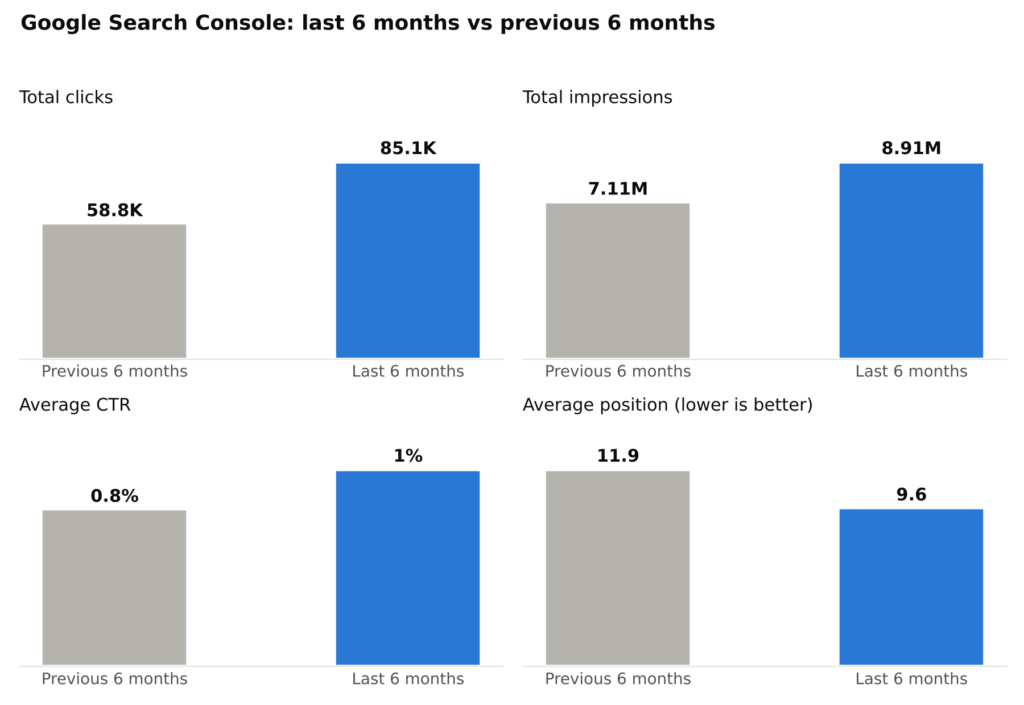
Clicks, impressions, CTR, and average position, before and after.
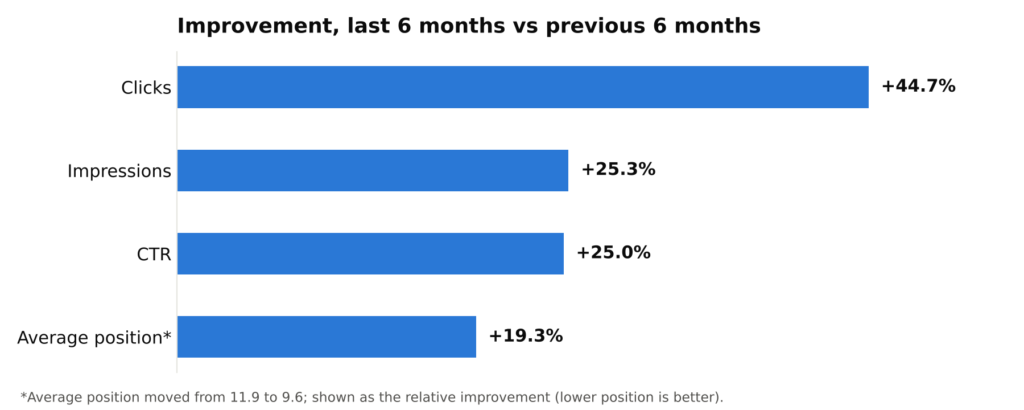
Relative improvement across the four Search Console KPIs.
What the Numbers Mean
- 26,300 more organic clicks. That is roughly 140 extra visits from Google every day, on average, across the six-month period.
- Clicks grew faster than impressions. Impressions rose 25.3% while clicks rose 44.7%. The brand did not just appear more often; it earned a bigger share of the searches it appeared for.
- Page one on average. Moving from 11.9 to 9.6 pushed the site’s average ranking onto the first page, where most hotel searchers make their decision.
- Sustained, not spiky. In the daily trend, current-period clicks stayed above the previous period for most of the six months, with a strong peak late in the window.
For an extended stay brand, the business value compounds. A single direct booking can cover a week or more of nights, with no third-party commission. More organic clicks mean more chances to convert travelers into loyalty members who come back. You can see similar patterns in our other SEO case studies.
Key Takeaways for Hotel Brands
- Fix the crawl before chasing rankings.
Parameter-driven location pages and weak canonicals quietly hold multi-location sites back. - Treat snippets as conversion copy.
When impressions are already high, better titles and descriptions are the fastest route to more clicks. - Make every location page earn its place.
Local context and long-stay details turn thin listings into pages that rank and convert. - Work the striking distance queries.
Keywords in positions 8–20 are the cheapest page-one wins you have.
Every vertical has its own search behavior, which is why we build industry-focused SEO programs instead of one-size-fits-all checklists.
Want Results Like These for Your Hotel?
If your property or brand is getting impressions but not enough direct bookings, we can show you where the clicks are leaking. Book a free SEO audit and consultation and we’ll map the technical, on page, and content opportunities specific to your site.
Frequently Asked Questions
How long does hotel SEO take to show results?
Technical and snippet fixes can move CTR within weeks. Ranking gains for competitive location queries usually build over three to six months, which is why this case study compares two six month periods.
Can a hotel brand really compete with OTAs in Google?
Yes. OTAs dominate broad queries, but brands can win location, brand plus city, and long stay searches with strong location pages, structured data, and well-written snippets.
What is the most important metric in a hotel SEO case study?
Clicks are the clearest signal because they represent real visitors who can book direct. Average position and CTR explain why clicks changed.
Does extended-stay hotel SEO differ from standard hotel SEO?
Somewhat. Long-stay guests search for kitchens, weekly rates, and practical amenities, so content and snippets need to answer those questions directly.